Computational Antitrust, 3rd Report
In a sentence
Third annual report with contributions from antitrust agencies
Meta
Type:
Report
Location:
Amsterdam
Year:
2024
URL:
https://papers.ssrn.com/sol3/papers.cfm?abstract_id=4861858
Abstract
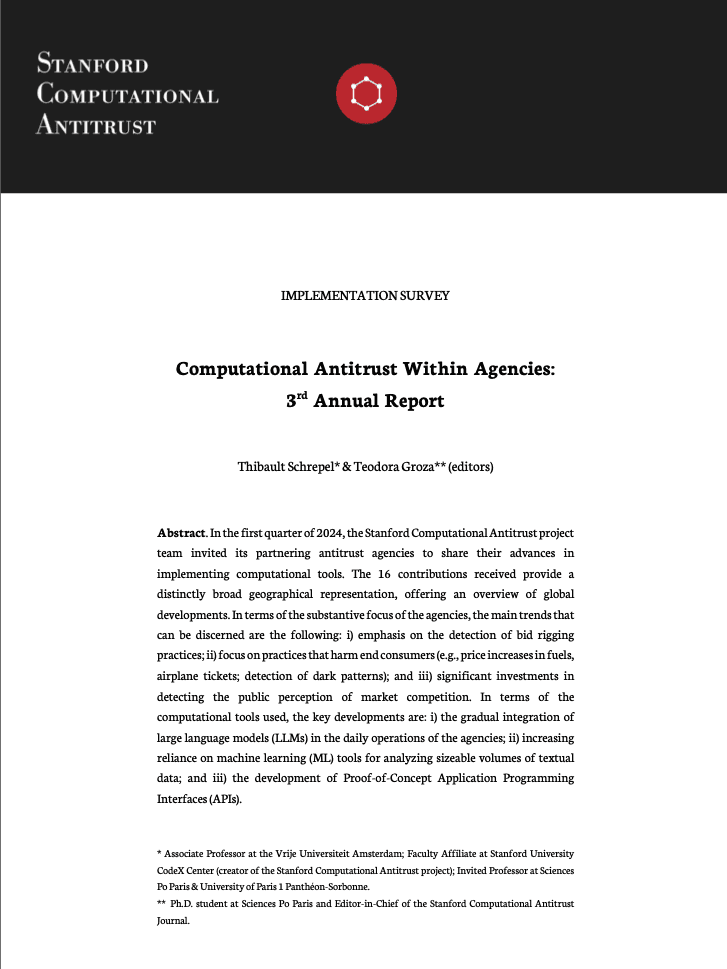
In the first quarter of 2024, the Stanford Computational Antitrust project team invited its partnering antitrust agencies to share their advances in implementing computational tools. The 16 contributions received provide a distinctly broad geographical representation, offering an overview of global developments. In terms of the substantive focus of the agencies, the main trends that can be discerned are the following: i) emphasis on the detection of bid rigging practices; ii) focus on practices that harm end consumers (e.g., price increases in fuels, airplane tickets; detection of dark patterns); and iii) significant investments in detecting the public perception of market competition. In terms of the computational tools used, the key developments are: i) the gradual integration of large language models (LLMs) in the daily operations of the agencies; ii) increasing reliance on machine learning (ML) tools for analyzing sizeable volumes of textual data; and iii) the development of Proof-of-Concept Application Programming Interfaces (APIs).

View more projects

